


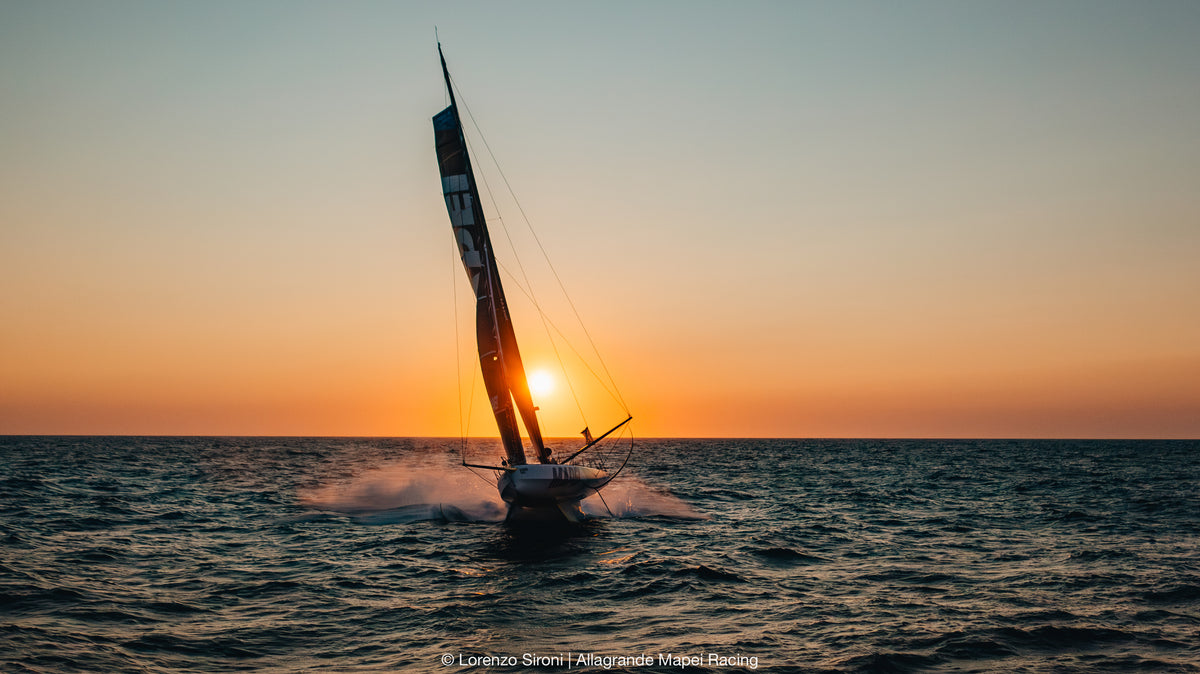
We didn't just race.
We did it while collecting data on the health of our seas.
During The Ocean Race Europe 2025, an instrument installed in the hull of the IMOCA Allagrande Mapei continuously filtered seawater, from Kiel to Boka Bay. Result: 26 samples, analysed in a laboratory, revealing which European seas are the most polluted and which microplastics are the most widespread.
Two universities, an offshore race and an international team to collect and analyse data on microplastic concentration in European seas.
The research took place in 3 phases: data collection during The Ocean Race Europe using a Microplastic Sampler installed on board, laboratory analysis in collaboration with the Università degli Studi di Milano, and statistical analysis of the concentrations found in collaboration with the Politecnico di Milano.
An instrument the size of a toolbox, designed to become one with the hull.
The instrument, a Microplastic Sampler supplied by The Ocean Race, continuously pumps seawater while the boat sails. The water passes through a pre-filter and then through 3 filters in series of 300, 100 and 30 microns, which trap both natural and non-natural particles. Every day a crew member changes the filter by hand and stores it in an aluminium box, ready for laboratory analysis.
The water intake is positioned in the boat's keel, 2 metres deep. Most global studies sample the surface; we check what's below the waterline, in the layer of water the boat passes through.

Over six legs, our boat filtered 6,459 litres of seawater.
Each filtered water sample is colour-coded according to the sea it was associated with in the analysis. The route follows the race's six legs, from Kiel to Boka Bay.

294 particles isolated under the microscope. 123 confirmed and characterised after laboratory analysis.
Distance from the coast and sea of origin. Two parameters, two stories.
The closer to the coast, the more polluted the water. The further away, the cleaner it is. Two broad groupings with similar pollution characteristics: seas outside and inside the Mediterranean basin. The Western Mediterranean and the Ligurian Sea are the most polluted seas, with the widest variety of different pollutant types.
Western Mediterranean, Ligurian Sea, Adriatic Sea
Atlantic Ocean and North Sea
The Central Mediterranean stands apart: it shows few elements overall, but a rich diversity of pollutant materials. An atypical case, sampled far from the coast.

Offshore sailing can make a significant contribution to scientific research by collecting oceanographic data, operating in a rigorous, sustainable and replicable way. A racing yacht sails in remote areas that are hard to reach, and can become a scientific platform. No dedicated vessel, no oceanographic campaign budget, just an instrument installed on board and a crew trained to collect data properly.